01 / Business problem
Why this product exists.
Paper records can be difficult to search, back up and reach across devices. A digital replacement must make those benefits available without making everyday writing feel foreign.
Digital ledger · Prototype
Prototype · core workspace needs further validation
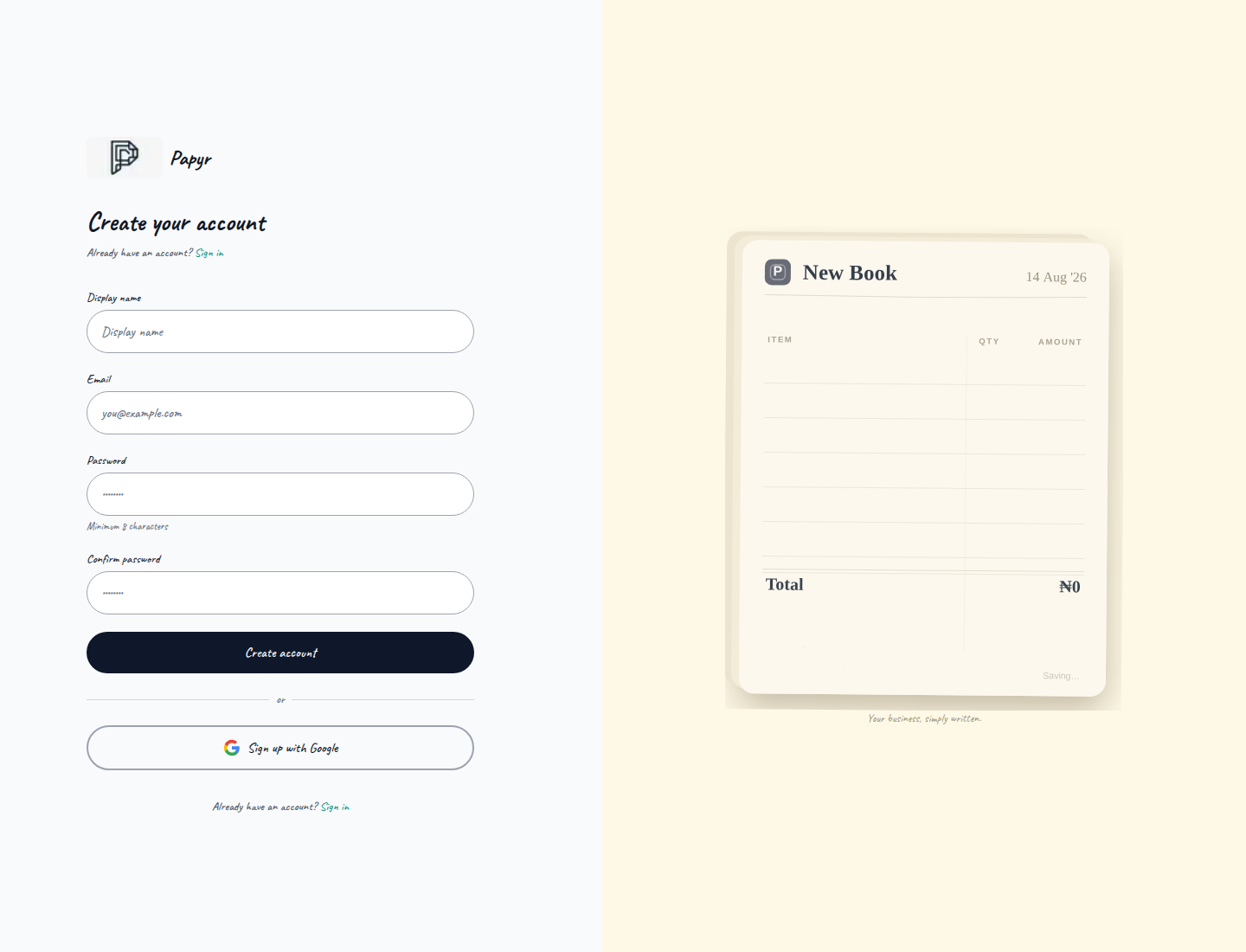
Papyr explores how people who keep records in paper books could move to a searchable digital workspace without losing the feel of writing. The repository contains a Next.js application, book-management screens and a layered ledger canvas.
People and small-business operators who prefer paper books for routine records.
This audience is the product brief’s hypothesis; the personas and success thresholds in the repository are plans, not verified customer research or outcomes.Prototype · core workspace needs further validation
Next.js 14ReactTypeScriptSupabase
01 / Business problem
Paper records can be difficult to search, back up and reach across devices. A digital replacement must make those benefits available without making everyday writing feel foreign.
02 / Product objective
Organize books and pages in a digital workspace while keeping handwriting as the intended primary interaction.
03 / Solution architecture
Module boundaries and data paths observed in source; this is not a live deployment diagram.
Next.js application and authenticated routes
React book and ledger workspace
Separate paper, grid and ink canvas layers
Supabase authentication and book data
04 / Engineering decisions
These notes describe the implementation found in the repositories—not measured product outcomes.
Paper, grid and ink are drawn on separate canvas layers so each visual surface can be initialized and redrawn independently.
Canvas setup uses the container’s measured dimensions, device-pixel-ratio scaling and a ResizeObserver; the repository’s older issue register still records a zero-dimension regression, so this path has not been certified here.
The ink hook builds strokes through a dedicated renderer and keeps history snapshots for undo and redo rather than treating each stroke as an unrelated image.
05 / Selected implementation
The current book list fetches records for the signed-in user and provides search, recent filtering, create and delete flows. In the inspected source, the displayed page count is still set to zero as a TODO rather than queried from the pages table.
06 / Current status and limits
07 / Potential improvements
A useful next conversation
Bring the situation, not a finished technical brief.
Discuss a project